reabc/Virginia New Afrikan Slave Revolutionaries - Uhuru B Rowe/Virginia New Afrikan Slave Revolutionaries - Uhuru B Rowe.pdf
Web PDF • Imposed PDF• Raw TXT (OCR)







VIRGINIA'S NEW AFRIKAN SLAVE
REVOLUTIONARIES :
A BLUEPRINT TO ACHIEVING LIBERATION
BY ANY MEANS NECESSARY!
zined-up on January 15, 2013
TABLE OF CONTENTS PAGE
“INTRODUCTION. ¢ evvurnniinennn..... Ll
~A HISTORY OF THE BLACK NATION IN U.S.A..2
-NEW AFRIKAN FREEDOM FIGHTERS. 3
~GABRIEL PROSSER. Ceeeeen e 4
-5
.7
~WHY WE USE NEW AFRIKAN.............. celdl
This zine and all of brother Brian' future
zines can be obtaihed for free (domation
appreciated) by simply contacting
For letters of solidarity, encouragement,
and support, please write to brother Brian
at:
Brian Lee Rowe #1131545
Buckingham Correctional Center
P.0. Box 430
Dillwyn, Virginia 23936
FOUNDER OF :
ANARCHIST BLACK CROSS-
VIRGINIA PRISON CHAPTER
INTRODUCTION 2
I am a 36 year old New Afrikan prison act-
ivist, jail house lawyer and a warrior in the
struggle for black liberation and true self-
deternination (by-any-means-necessary). I am
serving a 93 year prison sentence here in the
state of Virginia under its so-called "no
parole law or "85 percent” law. Consequently,
my prison sentence is no more than a life term
without parole. This law is designed to sym-
bolically "lynch" blacks here in this Common-
wealth while at the same time profiting off
our so-called slave labor.
After 18 years in prison I've become a
hardened rebel-with-a-cause, anti-capitalist,
anti-colonialist and imperialist, and a abol-
itionist of all forms of racism, torture and
oppression against the poor and disadvantaged
people of the earth, and a political revaluticrery .
I labored for some time to get this zine
completed. I encountered resistance from the
prison authorities here as well as inmate in-
formants who kept snitching on me for using the
typewriter in the law library to type this
zine, but to no avail. I have the blood of David Walker
pumping through my veins and the fire of all the past
late-great New Afrikan revolutionaries Larning beneath
my feet. Also a student of the older seasoned convicts
when I first came into this concentration camp, I, too,
an an extrenely disci; convict and I strictly follow
the convict code.without fail.
Originally, before I came into consciousness, I was
a Blood gang member "banging the battle of oppression.”
But once I began to read, learn and take in knowledge
and grow in wisdom, I realized that my oppression, as
a Blood gang member, came not from Crips, but from these
racist-imperialist-colonialist-capitalists who desire
nothing but to oppress and annihilate the poor people
Of the earth. So I cut my gang ties, refusing to be &
pawn of death, destruction and division amongst my own
precious people. And now with blood, sweat and tears, T
have given birth to this zine and my own Anarchist Black
Cross-Prison Chapter here in Virginia.
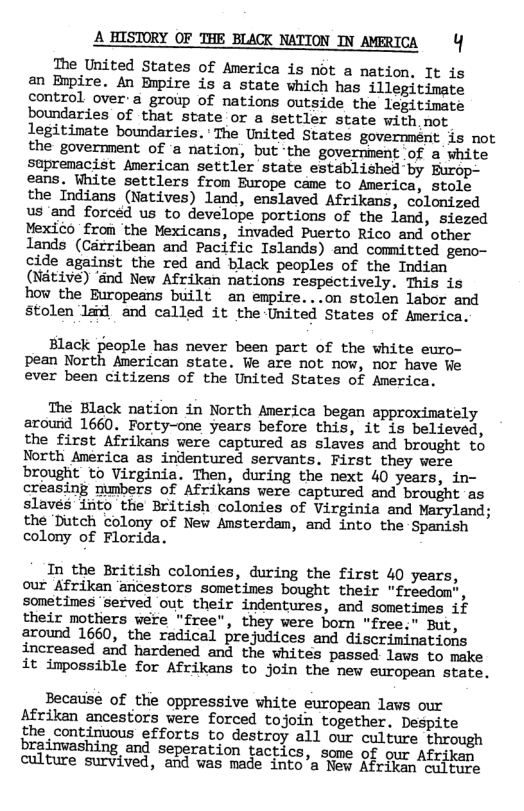
A HISTORY OF THE BLACK NATTON IN AMERICA Y
The United States of America is not a nation. It is
an Bupire. An Bnpire is a state which has illegitimate
control over'a group of nations outside the legitimate
boundaries’ of that state or a settler state with. not
legitimate boundaries. The United States governmént is not
the government of a nation, but-the government of a white
supremacist American settler state established by
eans. White settlers from Furope came to America, stole
the Indians (Natives) land, enslaved Afrikans, colonized
us ‘and forced us to develope portions of the land, siezed
Yexico from the Mexicans, invaded Puerto Rico and other
lands (Cdrribean and Pacific Islands) and committed geno-
cide against the red and black peoples of the Indian
(Nédtive) ‘and New Afrikan nations respectively. This is
how the Europeans built an empire...on stolen labor and
stolen la and called it the-United States of America.
Black people has never been part of the white euro-
pean North American state. Ve are not now, nor have We
ever been citizens of the United States of America.
The Elack nation in North America began approximately
around 1660, Forty-one years before this, it is believed,
the first Afrikans were captured as slaves and brought to
North America as indentured servants. First they were
brought to Virginia. Then, during the next 40 years, in-
creasing mmbers of Afrikans vere captured and brought as
slavés iiito the British colonies of Virginia and Maryland;
the Dutch colony of New Amsterdam, and into the Spanish
colony of Florida.
In the British colonies, during the first 40 years,
our Afrikan ‘ancestors sometines bought their "freedom”,
sometimes ‘served out their indentures, and sometimes if
their motliers were "free”, they were born "free." But,
around 1660, the radical prejudices and discriminations
increased and hardened and the whites passed lavs to make
it impossible for Afrikans to join the new european state.
Becausé of the oppressive white european lavs our
Afrikan ancestors were forced tojoin together. Despite
the continuous efforts to destroy all our culture through
brainvashing and seperation tactice. s of {ican
culture survived, ‘aig was e iats'a 0 Sh K, Afcjkan,
by our experiences in North America, and this New Afrikan
culture bound us strongly together as a New Afrikan nation
as long ago as 1660. This is why We say the New Afrikan
(Black) nation began in North America around 1660, and has
been held captive by europeans and Buro-Americans since
its birth. s
Our Afrikan ancestors merged into a New Afrikan nation
in the Black Belt Territory located on the Southeastern
corner of the American (USA) Bupire. This is vhy We were
held captive as slaves, on lands where We lived in abso-
lute majority until lynchings, rapes, cross-burnings,
assissinations, economic terror forced our people to flee
the Black Belt in large numbers. These refugees fled to
various cities in the Vest, Northeast and Midwest portions
of the United States Bupire. Some in fact fled to Canada
where their escaped slave ancestors has settled in earlier
years.
Even in the urban areas where the New Afrikan refugees
settled, our ancestors were murdered, abused and subjected
to all forms of discrimination and inhumame treatment.
Yet the rapid developement of American industry in the
North, financed largely from the stolen wealth produced
by our slave labor in cotten and tobacco fields in the
Black Belt, created some_jobs which were available to
our people. These were always the lowest paying, dirtiest
and most dangerous jobs. Indeed our economic condition
since slavery has merely been a modern-day extention of
slavery. As in slavery, We remain a Black underclass.
Inportantly, 53% of our total population never left
the Black Belt. Since 1973, more New Afrikans have been
moving back to the Black Belt than have been leaving.
NEW_AFRIKAN FREEDOM FIGHTERS
Throughout slavery and even on slaveships, during the
middle passage betveen Afrika and America, our ancestors
fought for freedom. In Averica, many armed slave rebels
fought to escape the plantation and to establish a free
Black state in the Black Belt. Nat Turner, Gabriel Proseer,
Demmark Vesey, and others were among the long list of
slave rebels who executed almost 300 known slave revolts.
A famous white anti-imperialist name John Brown led a
number of slaves in an unsuccessful armed attempt to set
up 2 Elack Nation state in the Black Belt. Numerous Black
Nation free commnities were periodically established by
escaped slaves. These: commnities endured for as long as
eight.years. ‘They rémained until deféated by superior
white military force. In one instance one of these free
states-lastéd for 75 years, in South Averica. In Florida,
an- American Indian-Afrikan nation-state called ‘the Seminole
Nation maintained its-independence off and on and con-
ducted continuous'armed struggle against the empire until
the late'1800's and early 1900's. Despite many heroic
efforts to establish Black Nation states in the 18th
and 19th centuries, our ‘fndependence struggle lacked
national coordination and political support. No political
formation was established which could organize the New
Afrikan Peoplé for'Peoplé's War; and properly raise pop-
ular ‘support for the revolutionary armed freedom Fighting
slave: rebels. Here T will fotus on:two New Afrikan slave
rebels/revolutionaries shom slave Uprisings started the
collapse of the plantation slavery system.
GABRTEL PROSSER (1775-1800)
With two.brothers, Gabriel, a skilled blacksmith; had
been the property of Thomas H. Prosser, whose estate lay
about six miles from Richmond, Virginia. He was six feet,
two inches in height, and assertive in manner. Taught to
read and write by his master's wife,, Gabriel epjoyed a
fair amount.of freedom for a siave, but wanted more.
Planning his wprising to, force the Copmonwealth of Virginia
to free black slaves and accept their demends for economic
equality, he organized more than a thousand slaves, in-
tended tp attack Richpond, the Capital of Virginia, where
black.slaves outnumbered whites 4to-1,.and oversaw their
arming with scythes, makeshift bayopets, clubs and, some
guns.. Although the revolt never occured, Gabriel .came to
be regarded as- the most militant abolitionist of his time.
They planned to seize to city arpory and teke hostages-
including Virginia Governor James Monroe- and demand mass
emancipation. He planned to kill all slave owners, but
spare the methodists and Quakers-vho he felt were sym-
pathetic to the black cause, along with vomen and children.
Quakers, especially in Pennsylvania, were adament' in
their opposition to slavery, and blacks’ then comprised
more than a quarter of all Amerikan Methodists.
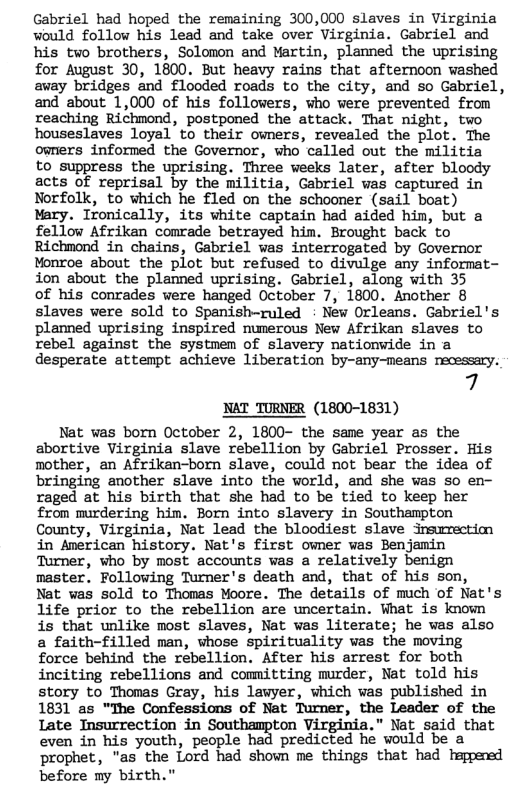
Gabriel had hoped the remaining 300,000 slaves in Virginia
would follow his lead and take over Virginia. Gabriel and
his two brothers, Solomon and Martin, planned the uprising
for August 30, 1800. But heavy rains that afterncon washed
away bridges and flooded roads to the city, and so Gabriel,
and about 1,000 of his followers, who were prevented from
reaching Richmond, postponed the attack. That night, two
houseslaves loyal to their owners, revealed the plot. The
owners informed the Governor, who called out the militia
to suppress the uprising. Three weeks later, after bloody
acts of reprisal by the militia, Gabriel vas captured in
Norfolk, to which he fled on the schooner (sail boat)
Mary. Ironically, its white captain had aided him, but a
fellow Afrikan comrade betrayed him. Brought back to
Richnond in chains, Gabriel vas interrogated by Governor
Monroe about the plot but refused to divulge any informat-
ion about the planned uprising. Gabriel, along with 35
of his conrades were hanged October 7, 1800. Another 8
slaves were sold to Spanish-ruled : New Orleans. Gabriel's
plamned uprising inspired numerous New Afrikan slaves to
rebel against the systmem of slavery nationwide in a
desperate attempt achieve liberation by-any-means necessary.
7
NAT TURNER (1800-1831)
Nat was born October 2, 1800- the same year as the
abortive Virginia slave rebellion by Gabriel Prosser. His
mother, an Afrikan-born slave, could not bear the idea of
bringing another slave into the world, and she vas so en-
raged at his birth that she had to be tied to keep her
from murdering him. Born into slavery in Southampton
County, Virginia, Nat lead the bloodiest slave Sneurection
in American history. Nat's first owner was Benjamin
Turner, who by most accounts was a relatively benign
master. Following Turner's death and, that of his son,
Nat vas sold to Thomas Yoore. The details of much of Nat's
life prior to the rebellion are uncertain. What is known
is that unlike most slaves, Nat was literate; he was also
a faith-filled man, whose spirituality was the moving
force behind the rebellion, After his arrest for both
inciting rebellions and committing murder, Nat told his
story to Thomas Gray, his lawyer, which was published in
1831 as "The Confessions of Nat Turner, the Leader of the
late Insurrection in Sout ton Virginia." Nat said that
even in his youth, people had predicted he would be a
prophet, "as the Lord had shown me things that had happened
before my birth."
Thanks to the influence of his grandmother, Nat's re-
Ligious faith grew, although not ordained, he becums
Baptist preacher, Nat's skill as a preacher, along with
his ability to read and write, earned him respect from his
fellov slave comrades. In addition, as a preacher, Nat way
glven more latitude and freedom and was thus able to roms
the countryside near his home. In 1825 Nat reached a turm-
ing point in his life. In “Confessions," he claimed he had
8 vision of "white and black spirits engaged in battle." 4
voice told him, "such in your luck, such you are called to
see." This episode, as vell as other visions he claimed
to experience over a period of several years, inspired Nat
to attempt to discover exactly what the Holy Ghost wanted
f hin. By 1828 Nat had concluded that he was destined to
bring about a revolution for his people and deliver then
from slavery, Nat confided his plans for revolution to the
four men who would become his most trusted comrades and
Lieutenants, forming the core of the revolutionary vangaurd.
In 1831 Nat believed that the time had come to liberate his
people and began to "arm and equip” his comrades. The re-
volt vas originally set to start July 4, 1831 but Nat fell
111, and not until Agust 21st did the most distructive of
all smerican slave revolts begin. Nat and his comrades be-
gan by killing his master, Joseph Travis (who had married
Thomas Moore's widow), and five other members of Travis'
family, sparing "neither age nor sex.” As Nat and his com-
rades blazed a trail of violence through the Southampton
County countryside, killing about 60 whites, they recruit-
ed more slaves to join the rebellion. When the 60 rebels
reached the town of Jurusalem, they were met by 18 armed
white men, whom Nat and his comrades easily repelled.
After a large group of militia joined the other whites,
the rebels panicked and retreated to the countryside. Nat
tried to recruit more men to his cause, but his efforts
vere in vain. The whites engaged in a manhunt, in retaliat-
don, massacring not only the rebels but innocent Afrikang
as well. Those who were not killed outright were tried and
gither executed or transported away. Nat eluded capture for
nearly two months but was finally taken into custody on
October 30, 1831, Nat vas quickly tried and found guilty.
On November 11, 1831, a white man with a rope broke Natis
neck on a gallows in a town in Virginia called Jerusalem.
While the whites suppressed the revolution with fair speed,
Nat and his comrades left in their wake a legacy ot tear
and paranoia amongst the white plantation owners and a
legacy of inspired rebellions anongst the slaves who de-
sired to be free by any means necessary. Southerners had
long dreaded that slaves might take up arms amongst them,
and Nat's action proved them right. To combat the possibi-
Lity of further rebellions, Southerners arrested and even
executed "suspicious” slaves and also tightened restrict-
ions on slaves' behavior, making a situation slaves had
already seen as intolerable even worse. Nat's rebellion
made the South more defensive than ever about its ' -
liar institution'.
In death as in life, Nat Turner was an example to his
oppressors. Until the end, he vas calm and cool, sure of
his act and the eventual vindication of history. Thomas
Gray said: "The calm deliberate composure with which Nat
spoke of his late deeds and intentions, the expression of
his friend-like face when excited by enthusiasm, still
bearing stains of the blood of helpless imnocence about
him, cloth in rags and covered with chains, yet soaring
above the attributes of man; I lookéd on him and my bleod
curdled in my veins."
(CONCLUSION
It vas these slave revolutions/rebellions/uprisings
which started the collapse of the plantation slavery
systen. Slave uprisings terrorized whites. These uprising:
illuninated the shadows of slavery and their revolts op-
ened a raging national debate concerning the institution
of slavery. These men who made this impact on the South
were black slaves who had not yet received their due in
history. They have been presented to history by vhite
authors who libeled them and : distorted their deeds. But
despite libels and distortions, Nat Turner and Gabriel
Prosser still sears the subconscious of this empire, be-
cause the gaping wounds they opened still runs.
The prototypes of 20th century revolutionaries, Nat
and Gabriel reminds us that oppression is a kind of vio-
lence which pays in coins of its own minting. They remind
us the first and greatest of all gospels is this: that
individuals and social systems alvays reap what they sow.
One cannot: understand Nat and Gabriel without under—
standing the reality they revealed and rejected. That
reality was American slavery, one of the cruellest social
stems designed by men. INn1s System was uesigucu 1O de~
roy the black man, Frederick bouglas, a former siave
and_ black abolitionist, put his finger on the heart of the
matter- He was, he said, "a slave of society, which has,
in fact, in form and substance, bound itself to-assist
the white man in robbing me of my rightful liberty and
the just rewards of my labor.” As a result, Douglas said,
“what rights I have against the slave master, I have eg-
vally against those confederated with him in robbing me
of my liberty. Since society has marked me out as privi-
ledge plunder, on the principle of self-preservation, I
am justified in plundering in return." "
In his book entitled, "Pioneers in Protest," Lerone
Benmett Jr., stated that "In the dynamics of oppression,
there are four stages of violence. In the original act
of violence, one group lays violent hands on another group
and reduces it to submission and degradation. This or-
iginal violence is sustained and perpetuated by institut-
ions (armies, police forces). Once. this happens, once
violence is imposed on a situation and imposed by violent
institutions, the situation itself and all the participant
in the situation are defined by violence. Violence becomes
the ambience of their being, and it whirls around and aro-
und within them, touching everything and sparing nothing."
"In the second stage of the oppression, the oppressed
group internalizes the origninal violence of the oppressor
If the oppressed group finds rio instrument, violent or mor
violent, for turning this violence from themselves, they
inevitably turn this violence upon themselves, killing
and maiming each other in rites of self-destruction. In
Nat's and Gabriel's day, as in our own, the internalized
violence of the'system comes out in many ways: in violent
language, in frienzies of religion and dancing and sex,
in the disparing acts of emasculated men who whipped their
wives because the massed violence of-the system prevented
them from whipping their tormentors." Lerone Bemnett Jr.
goes on to state what he is concerned to emphasize is
“that the violence that flows out of the system of opprest
ion is merely the objective violence of the system it-
self,” that the "violence of Nat and Gabriel was the re-
flected violence of their oppressors.” "As.children of
violence they became a transmission belt of violence in
an abortive attempt to free all men from violence.” And
in that attempt Lerone Bemett Jr. emphasized the third
iaw oI violence- ana that law is that violence always re-
bounds, alvays returns home. Nat's and Gabriel's revolts
was the violence boomeranging and returning hove. "And
of course, this brought into play the fourth moment of
violence; & miltiplication of the instruments designed to
suppress slaves. Thus, the violence of the system closed
in on itself. And in the process the system cracked under
the internal strain," Lerone Bemnett concluded. 12
Today ‘as. the year 2012 comes to a close,.the revolution
of the global -proletariat would soon be saméthing more
than a idle dream, as evident by the past revolutions in
the Middle East (Arab Spring), the Occupy Wall Street
Movement, and the uprising in Wisconsin when the govern-
ment tried to 'suppress/destroy the labor unions. The re-
volution should no longer be considered a black national-
ist agenda here in Amerikida. The revolution: should be .
2 global class revolution consisting of New Afrikans (blacks)
Latinos Asians, Natives, and poor whites who make
3p the poor, despised, rejected and oppressed people of .
the earth. As in Nat's and.Gabriel's day, soon there
#i11 be no more serfs, no more planters, no more classes,
10 more ‘Slaves, no more: exploited, despised, rejected,
200z and oppressed people on.the earth under global white
supremacy, capitalism, colonialism and.imperialism, only
nen.
I write this zine in love, respect, solidarity
and in the spirit of the struggle to all the
conrades locked—down across the whole prison
nation; the comrades serving life without parole
and on’death row who will never taste "freedom”
again. Let us not go down willingly on our knees,
but standing' with our back against the wall-
fighting back. Let's keep the fire of revolution .
burning beneath our feet and give these imperialist
Something that will make our late-great New Afrikan
Tevolutionary ancestors,who tried to take their
slave master's head off every chance_they got, some-
thing to be proud of.
Brian Lee Rowe
ramchist Black Cross- Virginia-Prison Chaptes
Buekingham Corr. Center, Dillwyn, Virginia
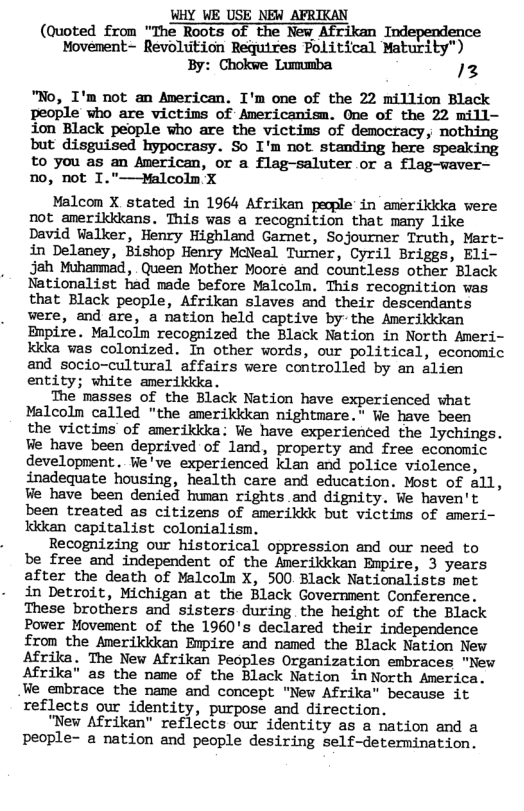
WHY WE USE NEW AFRIKAN
(Quoted from "The Roots of the New Afrikan Independence
Movement- Revolition Requires Political Maturity")
By: Chokwe Lummba 12
"No, I'm not an American. I'm one of the 22 million Black
people who are victins of Americanism. One of the 22 mill-
ion Black people who are the victims of democracy, nothing
but disguised hypocrasy. So I'm not standing here speaking
to you as an American, or a flag-saluter or a flag-waver—
no, not I."—Malcolm X
Malcon X stated in 1964 Afrikan pecple in amerikika vere
not anerildkans. This was a recognition that many like
David Walker, Henry Highland Garet, Sojourner Truth, Mart-
in Delaney, Bishop Henry McNeal Turner, Cyril Briggs, Eli-
Jah Muhanmad, . Queen Mother Moore and countless other Black
Nationalist had made before Malcoln. This recognition vas
that Black people, Afrikan slaves and their descendants
were, and are, a nation held captive by the Amerikikan
Bnpire. Malcolm recognized the Black Nation in North Ameri-
kida was colonized. In other words, our political, economic
and socio-cultural affairs were controlled by an alien
entity; white amerildda.
The masses of the Black Nation have experienced what
Malcolm called "the amerikkkan nightmare. We have been
the victims of amerikika: We have experienced the lychings.
We have been deprived of land, property and free economic
development. Ve've experienced klan and police violence,
inadequate housing, health care and education. Most of all,
Ve have been denied human rights.and dignity. We haven't
been treated as citizens of amerikik but victims of ameri-
Iddean capitalist colonialism.
Recognizing our historical oppression and our need to
be free and independent of the Amerikkkan Empire, 3 years
after the death of Malcolm X, 500 Black Nationalists met
in Detroit, Michigan at the Black Government Conference.
These brothers and sisters during the height of the Black
Power Movement of the 1960's declared their independence
£rom the Anerikikan Enpire and named the Black Nation New
Afrika. The New Afrikan Peoples Organization embraces "New
Afrika" as the name of the Black Nation inNorth America.
We embrace the name and concept "New Afrika" because it
reflects our identity, purpose and direction.
"New Afrikan" reflects our identity as a nation and a
people- a nation and people desiring self-determination.
New AITlKans nave been called “colored Americans," "Ameri-
can Negroes," "black Americans” and "Afro-Anericans.” The
New Afrikan Peoples Organization (NAPO) sees that all th-
ese tems confuse a unique New Afrikan Nation with a "comn-
on history, language, economic life, consciousness manif-
ested ‘in an‘commnity’of culture.” Just 2o orher ew Af
ikan Nations appear ‘today, fused together st
against slavery colonialisn ind imjerialism in Afrika (e g.
Zinbabwe, Ghana, Mozambique, etc.) and the Caribbean (Jam-
aica, Trinidad, Barbados, Grenada, etc.) We exist as a
new Afrikan nation in, North America, 14
.. "New Afrikan” reflects our purpose as Ve desire freedom,
self-deternination and independence, By stating We are New
Afrikans, We clarify We want to be independent from the
Amerikkkan Bnpire. We want land and national ljberation.
We no longer want the ruling class of the Amerikikan Em-
pire to determine our political, economic, socio-cultural
affairs. NAPQ sees that a People who do nof. control. their
own, affairs is subject to genocide. When We control.our
own’destiny We can determine our political, economic and
socio-cultural affairs in the interests. of our survival
and developerent, .
Our purpose is also to "free the land" -of New Afrika.
In 1968 the Provisional Govermment of the Republic of
New Afrika identified. the. states of South Carolina, .,
Georgia, Alabama, Mississippi and.Louisiana.as.the New
Afriken National Territory. NAPO believes that these
states and all areas in what, has been called the Black-
belt, South is oyr land..It'sthis land that We developed
substantiating .our reality as a .colonized nation..Oppress-
ed.nations who spccessfully, defeated. colonialism had to
usurp their identity from gppregsors. Zimbabweans had to
assert their freedm from Rhodesia; Mozambicans, Angolans
and Guinea-Bissan, Cape Verdans from Portugal; Algerians
and Guineans from the French. We must distinguish our
National Identity.from our.oppesssors. Revolutionary psy-
chiatrist ‘and Freedom. Fighter Frantz Fanon stated: “The
tearing away, painful and diffucult.though it may be, is
necessary. If it isn't accomplished there will be. serious
psycho.affective. injuries and. the. result will be individuls
without anchor; without a horizon, colorless, rootless- a
race of angels. It will be also quite normal to hear cer-
tain natives declare 'I speak as a Sengalese.and as a
Frenchman. ..'; !T speak as an Algerian and as a Frenchmen...'
The intellectual who is-Arab and French or Nigerian and
English, when he comes up against the need to take on two
nationalities, chooses, if he wants to remain true to him-
self, the negation of one of these determinations."
Grystalizing our identity as New Afrikans helps us
understand our reality as a colonized nation and what We
need to do to be free rather than being confused looking
for the system that oppresses us to free us. As New Afrik-
an Freedom Fighter Assata Shakur stated: "They have oppress
us for 400 years. They haven't let us live in Amerikkka.
They haven't let us be citizens. They haven't let us heve
justice, equality...so if they don't want to let us be
free as anerikkikan- then We'll be free as New Afrikans."
“New Afrikan" also speaks to our identity because that'
what We are. Our Nation is primarily a racial, cultural,
social fusion of various Afrikan ethnic and national grope
Ive, Yoruba, Akan, Ashanti, Fante, Hausa, Ibo, Fulani,
Congolese and several others- into a unique people. On
this land our ancestors worked as bondsperson (slaves)
without pay for theirlabor. Even though our homeland was
in Afrika, our people developed historical, economic,
and spiritual ties to the New Afrikan National Terrirtary.
After the Civil War where We put our energies together
to destroy the system of slavery, our people attempted
to control the land We had worked for free only to have
our efforts suppressed by the united states army, the
ku klyx klan and other white civilian armies. To state
We are New Afrikan recognizes our continuing aspirations
to "free the land."
"New Afrikan" also recognizes our direction to build
a New society based on new values. We reject to socio-
economic system and values of our oppressors. We want to
create a revolutionary, progressive, human society where
exploitation of hunans by.humans is eliminated and all
can live in dignity, peace and respect. As conscious New
Afrikans We work not to transform ourselves:and our Nation
from the decadent death-style of oppression to lifestyles
of liberation. Ve can't wait for sovereignty to rebuild
Liberation and survival institutions. Collectivity, co-
operation and commnity as opposed to selfishness, ego-
centrism, rugged individualisn are Afrikan values that
must be ressurected in New Afrikans.
We are New Afrikans. We are a Nation. We will be free.
NAPO will work to assert our diginity, purpose, and dir-
ection to continue the legacy of our ancestors; for our
own progress and the future of generations yet unborn.
Let us surface the New Aftikan Nation for ourselves,
all Afrikans, and all humanity.
South Chicago ABC
@ Zine Distro
Box 721/Homewood IL 60430